Any government determined to entrench itself in power must neutralize anyone capable of checking its authority: the Head of State, the judiciary, the media, and the opposition. Péter Magyar’s government accomplished all of this in less than one hundred days.
On 12 April 2026, TISZA, his party, won 141 of the 199 seats in Parliament. This gives it a two-thirds majority that allows it to amend the Constitution at will, without talking or coming to terms with anything or anyone. Fidesz, Viktor Orbán’s party, with 52 seats and almost two and a half million votes, has become the leading opposition force.
The government has christened the legislative package approved since then “Operation Purgatory”, and its declared objective is to “purge” alleged political, economic and institutional networks woven during Viktor Orbán’s years in office. It is worth setting out, however, what that “purge” has actually consisted of.
On 13 July, Parliament removes the head of state by means of a legal provision drafted for him alone.
The first article of the seventeenth amendment to the Constitution, approved by 139 votes in favor and 6 against, with the Fidesz and KDNP groups absent from the chamber in protest, establishes that the term of the sitting President of the Republic ends the day after the text enters into force. All of this followed repeated threats against the president himself from Magyar, who stated that he would amend the Constitution if he did not resign. Threats he has now made good on.
Tamás Sulyok, president since March 2024, sought to exhaust every avenue. On 29 May he requested protection from the Council of Europe’s Venice Commission. He also filed a request for interpretation before the Hungarian Constitutional Court itself. Seven justices recused themselves a few days later, citing an alleged conflict of interest, and the matter was never actually placed on the agenda. The Venice Commission, for its part, opened an urgent procedure and sent a delegation to Budapest on 2 July. The government approved the amendment without waiting for the Commission’s opinion.
Sulyok signed his own dismissal on 18 July and put on record in writing that he considered it “a grave and shameful historical example of the abuse of political power”, warning that the rule of law had come to an end in Hungary.
On 20 July, the office of head of state fell vacant and its functions passed on an interim basis to the Speaker of Parliament, a TISZA leader. The chamber has thirty days to elect a successor, and a majority sufficient to do so without reaching any consensus whatsoever with the opposition.
The same amendment expels four justices from the Constitutional Court, including its president.
This amendment reinstates compulsory retirement at seventy for members of the Constitutional Court, which forces out four justices two months after its entry into force. It also shortens the term of future justices from twelve to nine years and alters the system for appointing the presidents of the Kúria (the Hungarian Supreme Court) and of the National Office for the Judiciary. In other words, the body called upon to review the constitutionality of the reform approved by the government is itself modified by the very reform it was meant to review.
Half of the opposition’s members of parliament have been disqualified for life from standing for election.
Within this entire package of government reforms, an amendment has been approved declaring “ineligible” anyone who has served as a member of parliament for twelve years or has been elected on three occasions, counting terms already served retroactively. This permanently removes practically all of Fidesz’s experienced cadres.
In parallel, the TISZA majority, acting on Péter Magyar’s orders, has approved a two-term limit for the head of government, counted from May 1990 and applied retroactively. The sole target of this rule is Viktor Orbán, re-elected president of Fidesz on 13 June. In other words, Hungary’s government has passed a law conceived for a single individual, whose only purpose is to prevent the leader of the opposition and prime minister of Hungary for 16 years from contesting the premiership against the current head of government. A political party —TISZA— has arrogated to itself, in a European Union member state, the power to decide who its citizens may or may not vote for.
Both measures fly in the face of a bedrock principle of Western law, namely the ban on applying rules retroactively to someone’s detriment. Hungarian law itself forbids the practice. Article 2(2) of Act CXXX of 2010 on Legislation is explicit on the point: “legislation may not impose obligations, make existing ones more burdensome, withdraw or curtail rights, or render conduct unlawful in respect of any period preceding its entry into force.”
On 7 July, public television and radio went off the air, and their journalists were removed from the premises “for security reasons”.
At the end of June, Parliament approved a reform of the media law to terminate the mandate of the Media Council and dissolve the public media companies. Immediately afterwards, Parliament’s Culture Committee —controlled by TISZA— appointed to head them a management team led by a lawyer close to the party with no track record whatsoever in the audiovisual sector.
On 7 July, Hungary’s main public television channel and its main public radio station interrupted their broadcasts. The screens of millions of Hungarians went black, with a caption apologising “for the years of lies of the public service”. Several executives and journalists were dismissed on the spot, without notice or negotiation, and were removed from their offices by security staff. Péter Magyar declared that it was “a historic day”.
On 21 July, the Public Prosecutor’s Office enters the data center hosting the servers of the main opposition party.
On 21 July, the new government took a further step in its persecution of Fidesz: investigators from the Prosecutor’s Office and officers from the Tax Administration burst without warning into the data center housing the party’s servers and prepared to seize all of its equipment and files. The pretext is an investigation into the subsidies granted by the National Cultural Fund during Viktor Orbán’s governments, in which six people have been charged and several former officials are in pre-trial detention. The system seized, however, contains Fidesz’s membership records, its internal deliberations, its electoral and legal strategy and its correspondence with lawyers. In other words, Péter Magyar’s government has used a financial case of little relevance to hand the state apparatus a complete copy of the activity of the main opposition force. TISZA, unable to erase politically a party backed by almost two and a half million Hungarians, has decided to neutralize it by judicial means.
The backing of the European Commission and the European People’s Party
Since 2018, Hungary has been subject to a procedure under Article 7 of the Treaty on European Union. For seven years, the European Parliament has taken up “the Hungarian question” almost every week. The European Commission has published condemnatory annual reports on the alleged “lack of democracy” during Viktor Orbán’s time in office, going so far as to keep eighteen billion euros in European funds belonging to Hungarians blocked, citing supposed shortcomings in the rule of law, the public procurement system and the independence of the public media.
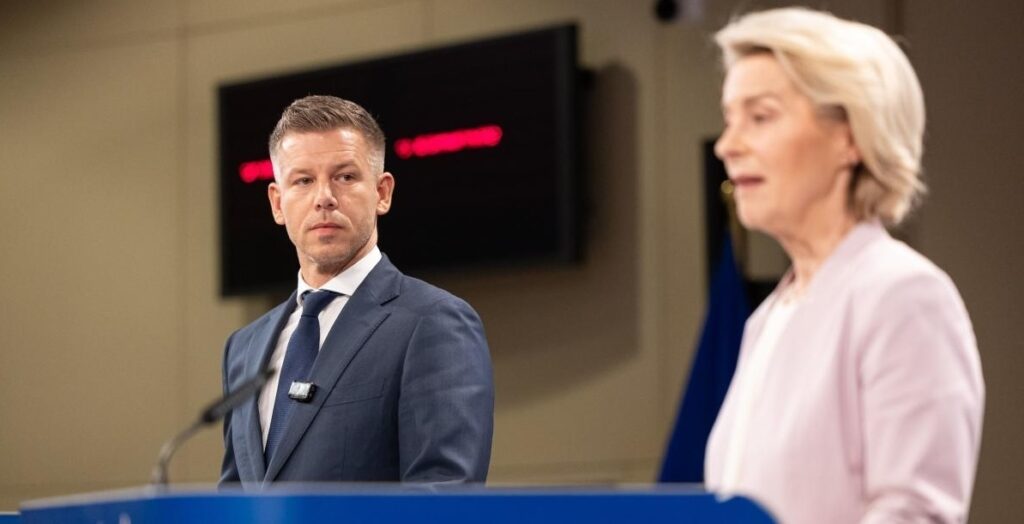
On 29 May 2026, a month after the change of government, Ursula von der Leyen and Péter Magyar appeared together in Brussels to announce the release of the European funds that had been withheld during Viktor Orbán’s government. “A strong wind of change can already be felt in Hungary”, the President of the Commission said at the time.
In early July, the European Parliament refused to hold a debate on the rule of law under the new Hungarian government. Apparently, “the Hungarian question” had ceased to matter. When the Spanish MEP and head of VOX’s delegation in the European Parliament, Jorge Buxadé, attempted to recall in plenary the seven years of weekly debates devoted to Orbán’s executive, President Roberta Metsola withdrew his right to speak.
On 13 July, the vice-chair of the Patriots for Europe group, Kinga Gál, together with several dozen MEPs, tabled a question to the Commission on the constitutional coup under way, which remains unanswered to date.
On 17 July, four days after the approval of the amendment expelling the Hungarian head of state, the European Commission published its annual rule of law report, praising the “intense reforms” undertaken by Magyar and referring, on the president’s removal, to the opinion the Venice Commission has yet to issue.
Manfred Weber personally negotiated TISZA’s entry into the European People’s Party.
Péter Magyar’s party belongs to the same European political family as Spain’s Partido Popular. Manfred Weber travelled to Budapest in June 2024 to negotiate TISZA’s incorporation into the group, which was approved with 97% of its MEPs’ votes. In his speech on being re-elected head of the European People’s Party, Weber stated that TISZA would put an end to Orbán in the spring of 2026. In other words, the formation that has removed the head of state, renewed the Constitutional Court, switched off the public media, disqualified half of the opposition and searched the servers of the main opposition party is the Hungarian delegation of the European People’s Party, endorsed by its president and celebrated by its leaders and partners, among them the Partido Popular in Spain.
All of these facts allow three conclusions to be drawn:
The first concerns Hungary. In a hundred days, a parliamentary majority has expelled the head of state, renewed the court charged with scrutinizing it, suppressed public news broadcasting, excluded the rival party’s leaders from electoral competition by law, endowed itself with a political authority subject to no power capable of controlling it, and gained access to all of the opposition’s data and communications, including conversations with its lawyers. All of it sold as a “democratic renewal”.
The second concerns the European Union. For seven years, Brussels turned Hungary into a permanent case file. It activated the Article 7 procedure, published condemnatory reports, multiplied debates in the European Parliament and kept eighteen billion euros blocked. With the arrival of Péter Magyar, all that scrutiny has vanished. The Commission has released the funds, praised the new government’s reforms, and avoided taking any position on the dismissal of the head of state. The European Parliament has refused to debate any of this, going so far as to withdraw the right to speak from those who tried to. The rule of law has once again been subordinated to the interests of a handful of bureaucrats.
The third concerns Spain. Pedro Sánchez has granted an amnesty to those behind the 2017 secessionist coup, brushing aside the Venice Commission’s objections and the measure’s evident unconstitutionality. He has left the General Council of the Judiciary deadlocked for five years. He appointed an Attorney General who went on to be convicted by the Supreme Court. He has normalised the practice of questioning judicial independence, with his ministers routinely attacking rulings that go against the government. He has captured the public broadcaster by installing allies in senior posts, and the private press through millions in state advertising. His government has passed a “Grandchildren’s Law” that will reshape the electoral roll by granting Spanish citizenship to almost three million people who have never set foot in the country, and a “Regularisation Law” that will hand legal residence to close to a million and a half applicants, many of whom will be eligible for citizenship after just two years.
None of it has brought him an Article 7 procedure, the freezing of a single euro of European funds, or so much as one weekly debate in the European Parliament. Hungary, meanwhile, has amassed seven years of proceedings and eighteen billion in frozen funds for doing nothing more than putting Hungarians’ interests ahead of the European Commission’s. Those who defend national sovereignty and liberty against globalism have a duty to denounce this for as long as Brussels’s silence continues to guarantee impunity for some and relentless harassment of others.